
Origin of Cosmos
- SS Malik
- Oct 8, 2024
- 8 min read

|
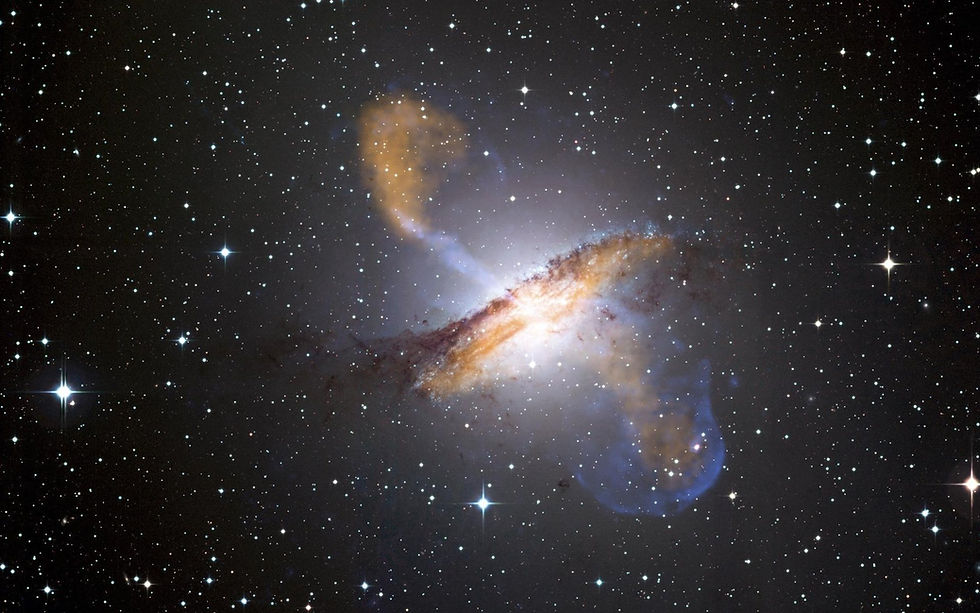
The most popular theory of our universe's origin centres on a cosmic cataclysm unmatched in the entire history, the Big Bang. A Belgian priest named Georges Lemaitre suggested the Big Bang theory in the 1920s. This theory was born of the observation that other galaxies are moving away from our own at great speed, in all directions, as if they had all been propelled by an ancient explosive force. Big Bang proponents suggest that some 10 billion to 20 billion years ago, a massive blast allowed all the universe's known matter and energy, even space and time themselves, to spring from some ancient and unknown type of energy.
The theory maintains that, in the instant, a trillion-trillionth of a second after the big bang, the universe expanded with incomprehensible speed from its pebble-size origin to astronomical scope. This expansion has apparently continued, but much more slowly, over the ensuing billions of years.
Scientists are not sure exactly how the universe evolved after the Big Bang. Many believe that as time passed, and the matter cooled, more diverse kinds of atoms began to form, and they eventually condensed into the stars and galaxies of our present universe.
Before the Big Bang, scientists believed the entire vastness of the observable universe, including all of its matter and radiation, was compressed into a hot, dense mass just a few millimetres across. This nearly incomprehensible state is theorized to have existed for just a fraction of the first second of time. The glow of cosmic microwave background radiation, which is found throughout the universe, is thought to be a tangible remnant of leftover light from the Big Bang. The radiation is akin to that used to transmit TV signals via antennas. But it is the oldest radiation known and may hold many secrets about the universe's earliest moments. The Big Bang theory leaves several major questions unanswered. One is the original cause of the Big Bang itself. Discoveries in the early 20th century [1] have suggested that the Universe had a beginning, and that space has been expanding since then [2], and is still expanding at an increasing rate [3].
The Big Bang theory is the prevailing cosmological description of the development of the Universe. Under this theory, space and time emerged together 13.799±0.021 billion years ago [4] with a fixed amount of energy and matter that has become less dense as the Universe has expanded. After an initial accelerated expansion at around 10−32 seconds and the separation of the four known fundamental forces, the Universe gradually cooled and continued to expand, allowing the first subatomic particles and simple atoms to form. Dark matter gradually gathered, forming a foam-like structure of filaments and voids under the influence of gravity. Giant clouds of hydrogen and helium were gradually drawn to the places where dark matter was most dense, forming the first galaxies, stars, and everything else seen today.
Big Bang theory fails to explain from where the initial compressed matter came or originated, and what triggered the giant explosion. The assumption of the availability of compressed matter itself indicates that it was not the beginning and merely a transformation.
Beginning of Universe
Georges Henri Joseph Édouard Lemaitre was a Belgian Catholic priest, mathematician, astronomer, and professor of physics at the Catholic University of Louvain. He was the first to identify that the recession of nearby galaxies can be explained by a theory of an expanding universe. Lemaitre had called the initial point in his theory as ‘Primeval Atom’ or the ‘Cosmic Egg’, exploding at the moment of the creation". This theory later came to be known as the "Big Bang" theory after a sarcastic remark of the English astronomer Fred Hoyle in 1949. The word theory has originated from Greek theōria which means contemplation, speculation or from theōros ‘spectator’. The root word is theos (θεός) which means god and also infers stars and their movement. Therefore, a theory always points to god if it is in search of truth or reality.
The theory of creation in Vedic literature described the initial point as Hiranyagarbha (golden womb or golden egg). The theory of creation is described in ‘Bhagavata Purana’, ‘Bhardwaj Samhita’, ‘Aitray Brahman’ and ‘Manu Samiriti’ where Brahma (consciousness) impregnated the golden womb and expanded it. It is a theory of a local universe or a galaxy and not of the main universe. The main universe did not begin from a big bang as popularly believed, but it began in a continuous orderly fashion.
What prevailed before the beginning of the universe and in its centre is the great void or zero, cypher or numeral 0 (also known as Mahashunya - The absolute zero). At that point, there was only one dimension, Consciousness and no space, no time and no matter.
Consciousness may be defined as a fact of awareness by itself (itself being the interpreter) and also as intelligence or sentience with the ability to control itself and its surroundings. Consciousness is the reality that creates and it is reflected by the inherent mathematics in the design of the universe. One can also draw an analogy to a super-intelligent computer program that is self-aware and capable of controlling itself and the environment.
The universe was created with a definitive resolute thought (Sankalpa). The purpose of its creation could be enhancement or purification of consciousness or just entertainment. Nothing can be said about it and no scriptures mention it. The creator is also known as Parabrahma (Beyond Universe).
Vedas say that the universe was created from nothing, and if it is ended it will become nothing. The word, “Amen,” and “Aum” is the beginning of the Creation.
तत्सर्वशक्ति बीजजडप्रकृतिवासनाया व्यक्तभावः ।
प्रणवशब्द: दिककालाणोऽपि तस्य रूपाणि ॥ ३ ॥
That omnipotent source (seed) has created nature. Aum transforms in Space, time matter etc.
ऊर्ध्वमूलमधःशाखमश्वत्थं प्राहुरव्ययम्।
छन्दांसि यस्य पर्णानि यस्तं वेद स वेदवित्।।15.1।।
Sri Krishna says in Gita Chapter 15 Verse 1, this universe is like a tree with roots on top and branches downwards and it is dynamic, non–eternal (like a reflection of a tree in a lake below) and its leaves are knowledge (the mathematics which builds universe). The one who understands this aspect of the universe is knowledgeable.
The top tree on the lake is Consciousness (Parabrahma) and from the sustained thought of that, has created the reflection.
तदेव जगत्कारणं माया ईश्वरस्य, तस्य व्यष्टिविद्या ॥ ४ ॥
That is the root cause of the universe. Maya belongs to him; this is the knowledge of Maya which has been applied. Maya can be seen as an illusion or mystery, a key phenomenon used by the consciousness to create nature. Maya is a scientific phenomenon which helped superconscious programs to initiate the vibration and then matter out of those vibrations. How can some vibration however small and unmanifested come out of nothingness is indeed a great mystery. The creation of the first vibration from nothingness (Shunya) is known as Mahamaya. No one has been able to decipher what is Mahamaya. It is the source code of the first re-iterating equation. As the formation of the universe progresses from step zero to one and further, at each step whatever new forms, appear completely different from the original ingredients. This is known as Maya (illusion). For example, hydrogen is a flammable gas and oxygen is a gas which aids combustion and their combination is water which helps douse the fire. At the next level from elements to compounds, the nature of matter has changed to a completely different set of characteristics. The changed characteristics differ completely from the original is an illusion which is described in Vedas as Maya. From the beginning of creation to the completeness of the universe, there are 96 levels of Maya.
मनः सृष्टिं विकुरुते चोद्यमानं सिसृक्षया।
आकाशं जायते तस्मात् तस्य शब्दं गुणं विदुः ॥ १-७५
Mind, impelled by the desire to create, performs the work of creation by modifying itself, thence ether is produced; they declare that vibration is the quality of the latter.
John 1:1 is the first verse in the opening chapter of the Gospel of John. The verse reads: In the beginning was the Word, and the Word was with God, and the Word was God. The word here describes the vibration (the nearest contextual meaning being vibration). The initial vibration was manifested with three Gunas (Sat, Rajas and Tamas). At the moment Sat can be understood as knowledge (truth, reality, purity), rajas as control and tamas as binding forces. Therefore, Sat (also known as truth) is the intelligence riding in every corner of space, wavelets and particles and their future heavier and larger outcomes.
As we would need to format a memory drive to store information, the space was also formatted for the creation of the universe. Universe extended from a point. Therefore, as a first move, the space was created. This formatting is dark matter. The initial Vibration is Prana (Aum). This is the background sound of the universe, the rest of everything is its multiple echoes’. The same echo can also be heard in the sound of the stars. There is a reference in ancient texts in Sanskrit giving us a glimpse of supreme consciousness.
तत्र सर्वज्ञप्रेमबीञ्चित् सर्वशक्तिबीजमानन्दश्च ॥ २ ॥
The creator is omniscient, omnipotent full of love and bliss. This quality is reasonable because one who is creating knows what he is creating and since he is the only one and powerful enough of creating. The supreme consciousness can also subdivide and represent various forms (like a main program may have many sub-programs and modules which can function in an interconnected/ embedded manner or independently.
The idea of creation from nothingness to expanding spheroid (Brahmand) starts from the integration of initial vibration Aum with time, forming space and non-manifesting wavelet strings. These wavelet strings further integrate in time and space using many combinations and permutations of conjunctions and disjunctions creating forces and the wavelets, strings, waves, rays, unstable elementary particles, quarks and so on.
आकाशात् तु विकुर्वाणात् सर्वगन्धवहः शुचिः।
बलवाञ् जायते वायुः स वै स्पर्श-गुणो मतः॥ १-७६
But from the Aether (space), changing itself, springs the pure, powerful wavelets, the vehicle of all perfumes; that is held to possess the quality of touch (exertion of force, a cause).
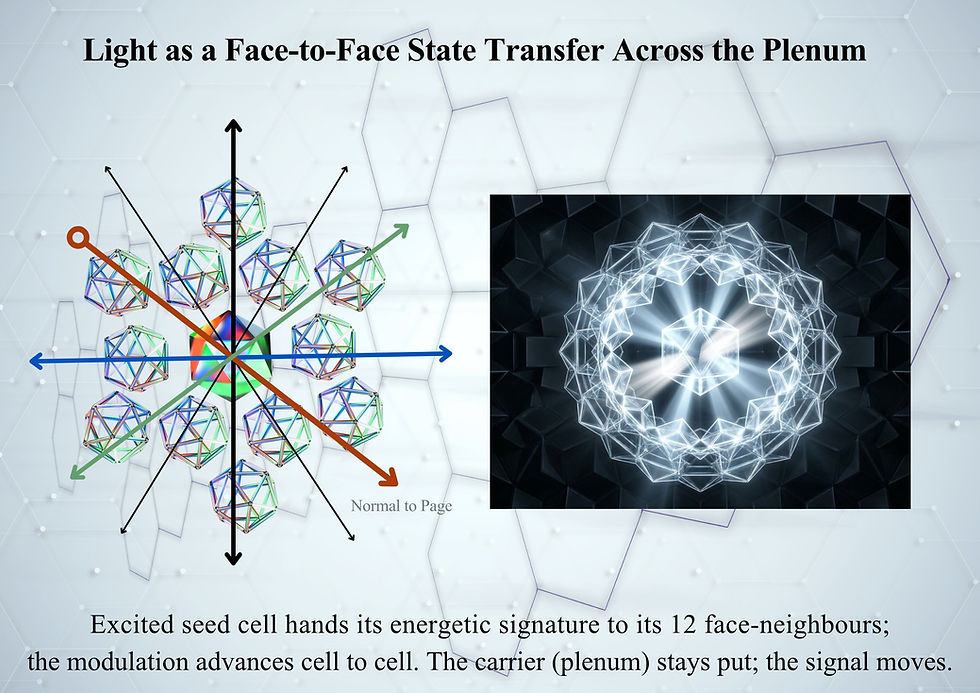
Next from wavelets modifying (by combining in various permutations and combinations), proceeds the brilliant light, which illuminates and dispels darkness; is declared to possess the quality of colour (visibility).
वायोर् अपि विकुर्वाणाद् विरोचिष्णु तमोनुदम्।
ज्योतिर् उत्पद्यते भास्वत् तद् रूप-गुणम् उच्यते ॥ १-७७
The entire process is the formation of the universe is autonomous barring some intelligent interference. This principle is known as ‘Mahat’ (great principle or a principle which leads from small, unmanifested things to great things). Mahat is the mathematics behind the magic numbers and wave geometry for the formation of space, energy and matter forms.
Sanskrit words are meaningful, appropriate and concise. The word ‘Brahma’ means expansion (Br) and ‘Amha’ (am, Aum sound). This means the program took care of the expansion of the initial ever-expanding vibration. He also formatted the 3D space. The space-time fabric is one of the Maya (techniques, illusion) of Brahma. The Brahmand is suffixed with ‘and’ meaning spheroid. The word ‘Brahmand’ means an expanding spheroid. The one word describes it all. Since the beginning took place from a sustained, purposeful thought of consciousness and it is continuous, extending to the surface of a seemingly infinite sphere. Even now ‘the vibration’ may be generated in the same manner it started the universe in the beginning and therefore the universe is continuously forming and hence, also expanding.


Comments