
The Cosmos is an Engineering Masterpiece.
- SS Malik
- May 24
- 5 min read

Updated: May 29

For nearly a century, we have been told we inhabit an infinite, entropic void, a chaotic residue of a violent "Big Bang". In this standard narrative, the universe is a 93-billion-light-year bubble of dark energy where galaxies drift like lonely sparks in a graveyard of dead stars. It is a vision of reality defined by existential dread and statistical accidents. However, the 2026 treatise by Dr Satinder Singh Malik, The Shape of the Cosmos, re-architects this foundation entirely. Malik suggests that our perception of the "infinite" isn't a discovery but a refractive illusion.
Malik’s work on Informational Magneto-Electrodynamics offers a fundamental re-evaluation of the global architecture of our reality. Instead of a runaway explosion, he proposes the "Big Bloom", a purposeful, ordered unfolding of a finite, three-layered machine. By synthesising the ontological frameworks of the Upanishads with high-level physics, Malik reveals that the Cosmos (the ordered totality) is vastly smaller, more stable, and more intricately engineered than we ever imagined. The following takeaways deconstruct our reality, replacing the entropic void with a harmonically tuned masterpiece.
The Illusion
The most jarring shift in Malik’s model is the true physical scale of the cosmos. While modern astronomy accepts a diameter of roughly 93 billion light-years, Malik derives a true physical radius of only approx 20.17 billion light-years. The reason we perceive a vast, receding expanse is that we are living in a "cosmic hall of mirrors".
The outer boundary of the cosmos, known as the Turbulent Fringe (Zone III), acts as a hyper-dense specular density wall. This "holographic mirror boundary" possesses near-infinite impedance; light waves cannot penetrate it and instead undergo a specular back-reflection into the interior. As Malik deconstructs the phenomenon:
"The curved density wall acts as a giant concave mirror, catching the light of real galaxies and projecting them back as virtual ghost images. An interior observer sees the same physical galaxies repeated many times over, creating the optical illusion of an infinite universe... when the true physical container is only 20.17 billion light-years across."
This realisation trades existential dread for structural comfort. The night sky is not an infinite graveyard but a "closed toroidal chamber" where light is recycled and structure is conserved. We aren't lost in a void; we are inside a finite, perfectly closed system where every "distant" galaxy is a virtual ghost image bouncing across the macro-chakra.
Pi and Phi (the Golden Ratio) are Literal Hardware Specifications

In Malik's framework, universal constants are not random "magic numbers" but structural necessities for the universal spatial motherboard. This is governed by the Cosmic Harmony Condition. The middle layer of the cosmos, the Rajasic magnetic torus, functions as the active drive system and is governed by a specific geometric lock: the R/r = phi harmony condition, where the major radius (R) and minor radius (r) stand in the golden proportion (Phi approx 1.618).
Structural Geometry (pi): Malik reveals that pi is the literal count of "digital pixel blocks" (22) required to form a smooth wheel around a core of 7 spatial units. This 22/7 ratio isn't a mathematical abstract; it is a hardware requirement for the poloidal and toroidal loops of the cosmic dynamo.
The Golden Ratio (Phi): This ratio dictates the structural tilt of the space matrix faces.
These ratios appear in galactic spiral arms and plant life because they are built into the "cosmic drive layer". They are the beauty ratios of a harmonically engineered system, ensuring the spatial matrix can tile perfectly without shear.
The "Expanding Universe" is a Refractive Error
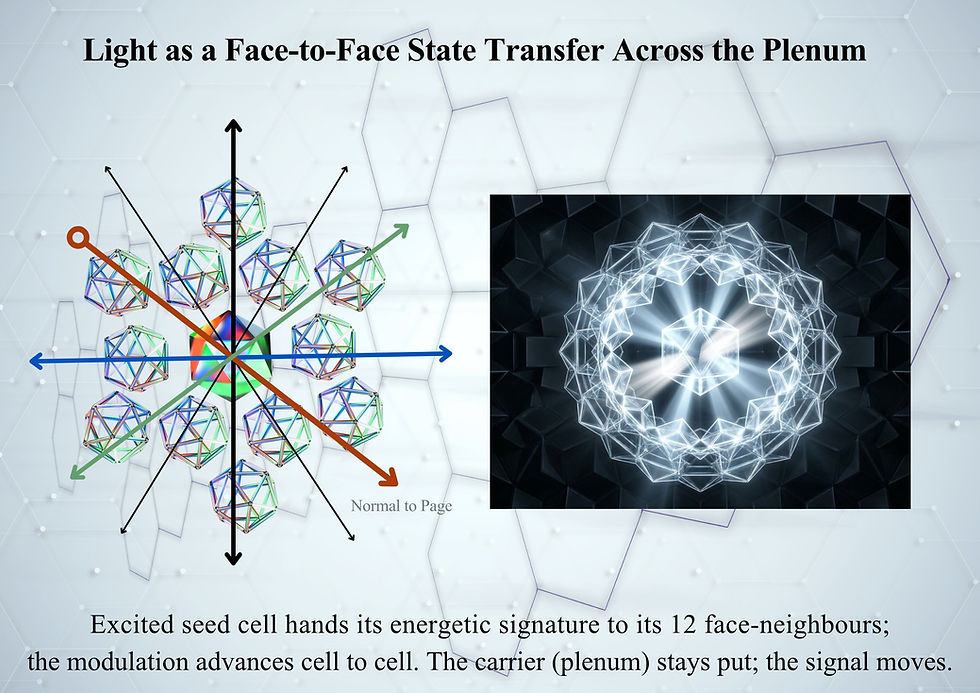
The standard model relies on "Dark Energy" to explain why distant galaxies appear to recede (redshift). Malik argues this is a misunderstanding of how light interacts with the Celestial Plenum, a compressible, viscous, dielectric quantum foam that fills the cosmos.
According to the theory of Variable Speed of Light, light travels at a c/4 speed in the relaxed, low-density intergalactic void. However, as light enters our high-density local neighbourhood, the "compressed plenum" of our solar and galactic vortices, it experiences "refractive bending".
"In this framework the cosmos is not expanding; light is simply slowing as it enters dense local space."
The rising density of the plenum acts as an aerodynamic brake, slowing the light wave to our locally measured 1c. Astronomers misidentify this slowing as a Doppler recession. In Malik’s "Big Bloom," the universe isn't rushing away from us; our local environment is simply thicker, slowing the messages from the stars as they arrive.
The Universe is a Nested Three-Layer Machine
Malik replaces the concept of a uniform vacuum with a three-layer architecture based on the "three attributes of energy" (Gunas). This machine is anchored by a central "Dark Star" stator:
The Sattvic Sphere (Information): The outermost layer, a frictionless matrix of rhombic dodecahedral cells that carries the "geometric blueprint" and enables quantum entanglement.
The Rajasic Torus (Magnetism): The middle drive layer. This is a humongous magnetic dynamo that torques celestial bodies and transmits angular momentum.
The Tamasic Disc (Baryonic Matter): The innermost layer, or Cosmic Chakra. This is a flat, hollow equatorial disc where all visible stars and galaxies float.

Crucially, Malik re-architects mass as a bipartite concept. He distinguishes between Mahatva (the inert nucleonic anchor) and Gurutva (the interactive effective mass). What we perceive as gravity is the pressure gradient of the plenum acting on the Gurutva of a body. Matter is held in a flat plane by the Chakra Confinement Equation, where magnetic pressure acts as a "vise" (a macroscopic Z-pinch), crushing the outward-flowing plenum into a razor-thin sheet.
The Base-13 Fractal Logic of Reality
Space is not empty; it is a "Rhombic Honeycomb" made of Rhombic Dodecahedral cells. This specific geometry is the only convex polyhedron that tiles space with 100% volumetric efficiency. Malik shows that the cosmos follows a Base-13 fractal scaling law, scaling from the "seed crystal" at the centre outward in levels of 13, 169, 2,197, and beyond.

This fractal architecture is governed by the Plenum Influence Parameter (PIP), the kinematic invariant of every cosmic vortex. Malik’s Quadratic PIP Resonance Law (Φ_{Gal} / Φ_{Sun} ≈ (Φ_{Sun} / Φ_{Earth})^2) proves that the same rules govern Earth, the Sun, and the Galaxy. This allows for the Convergent Volumetric Series, resolving a major paradox:
The cosmos has infinite interior resolution (as you move toward the core, cells shrink but increase in count).
The total volume is strictly bounded at approximately 12.07 times the volume of a single outer master cell.
The universe is a self-similar fractal where the "neutrino-pixel" at the subatomic scale and the "galactic-grid" at the macro scale are written in the same geometric code.
Conclusion: From Explosion to Bloom
Dr Malik’s 2026 treatise invites us to trade the "Big Bang" for the "Big Bloom". The former describes a chaotic accident destined for "heat death"; the latter describes a purposeful, ordered unfolding of structure. In this view, we do not live in a runaway explosion but in a stable, recycled, and harmonically tuned machine.
If our "infinite" sky is actually a beautiful, finite masterpiece of engineering, a closed toroidal chamber where light is recycled and every constant is a hardware spec, it changes our fundamental relationship with the stars. We must ask ourselves: Is the vastness of the night sky a sign of our insignificance, or is it a testament to the staggering precision of the "spatial motherboard" we inhabit?


Comments