
Why Light Doesn’t Travel and Space is a Rhombic Mosaic
- SS Malik
- May 27
- 5 min read

For over 300 years, physics has been haunted by an unresolved identity crisis. Is light a stream of ballistic particles, as Isaac Newton imagined, or a wave propagating through a medium, as Christiaan Huygens argued? Modern physics attempts to manage this tension through the doctrine of wave-particle duality, a conceptual truce that suggests light is somehow both, depending on how you look at it.
However, a revolutionary reformulation known as the Info-Magneto-Electrostatic (IME) framework suggests that this duality is not a law of nature, but a category error. By reimagining the “vacuum” of space as a structured “Celestial Plenum,” we can resolve these ancient contradictions. If we grant the premise of a structured vacuum, we are forced to conclude that the “photon” is not a traveler at all, but a handshake.
This framework is built upon a five-domain vedic ontology, Space (S), Time (T), Energy (E), Matter (M), and Consciousness/Information (C), where any existence is defined by the ordered tuple O = (s, t, e, m, c). Within this structure, light is the most basic message available for reading the cosmos. Here are the six most counter-intuitive takeaways from this paradigm shift.
The Necessary Geometric Correction: Space as a Rhombic Mosaic
The IME framework begins with a foundational claim: Space is a “fully saturated” medium. To be physically viable, this medium must be composed of cells that tile three-dimensional space perfectly, leaving no gaps. While classical thought often associated the cosmos with the regular pentagonal dodecahedron, that Platonic solid could not pack space without leaving wedges behind.
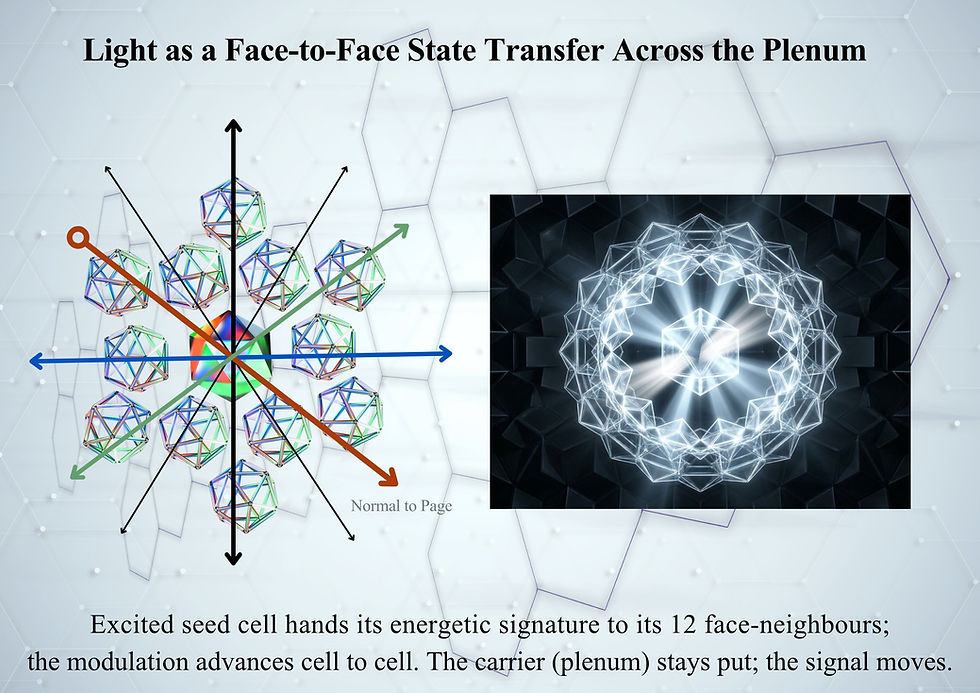
The “necessary geometric correction” identifies the rhombic dodecahedron as the true unit of space. This twelve-faced solid is the Voronoi cell of the face-centered cubic lattice, the densest regular packing of equal spheres. This geometry naturally satisfies the “Base-Thirteen Clustering Law”: one central seed cell locked in a twelve-neighbor embrace.
To ground this in the physical, the framework anchors the edge length of these cells to the smallest stable structure in high-energy physics. The base channel is identified with the neutrino, possessing an edge length of approximately 1.22 \times 10^{-18} meters.
“Space is treated not as an empty void but as a formatted, fully saturated medium, the Celestial Plenum, partitioned into space-filling rhombic dodecahedral channels.”
Light Doesn’t “Travel”, It’s a Face-to-Face Handshake
In the IME model, light is not an autonomous object that “flies” through a void. Instead, it is a Face-to-Face State Transfer. When a source excites a specific space channel, that channel cannot hold the energy in isolation; it is rigidly face-bonded to its twelve neighbors. It hands the “energetic signature” across its twelve faces, which then pass it to theirs.
This mechanism dissolves wave-particle duality by distinguishing the carrier from the signal. Using the “water vs. wave” analogy: when an ocean wave crosses a bay, the water stays put while the pattern moves. In a dense plenum, transporting a physical object would be impossibly lossy due to drag. A modulation, however, survives cosmological distances because it transfers state without transporting the medium. The “photon” is merely the name we give to a single arrival of energy when an absorber (like a detector) registers it.
“The carrier (plenum) stays put; the signal moves.”
The “Blind Spot” at the Source: A Falsifiable Prediction
A profound consequence of this geometric model is the prediction of “source-point blindness.” Vision and detection require a differential, a gradient of state across the faces of a space channel.
At the exact locus of emission, the medium is saturated isotropically (equally in all directions). Because the gradient at this precise point is zero, an observer located exactly at the source would be unable to “see” the emission. This is a unique “geometric prediction” entirely absent from the standard particle-based picture. This is testable: Experiment A proposes using quantum-dot photodetectors at fractional-nanometer increments from a nano-emitter to detect the small, anisotropic, step-wise drops in intensity as the detector crosses the vertex regions of the channel lattice.
Einstein’s Lens, Malik’s Glass: Why Gravity is a Refractive Index
Standard physics describes gravity as the warping of a four-dimensional spacetime fabric. The IME framework offers a mechanical alternative: Gravity is ordinary refraction.
The presence of matter compresses the surrounding plenum, increasing its local permittivity and permeability. This changes the “refractive index of space.” Just as light pivots when it enters a dense piece of glass, a wavefront of light grazes a mass like the Sun and slows on the side nearest the mass, causing the path to bend.
To maintain scientific rigor, the framework acknowledges a “Risk Register” item here: while it recovers the Shapiro delay and the form of gravitational lensing, it requires a doubled permittivity gradient (n = 1 + 2\Phi/c^2) to match the observed 1.75 arcseconds of deflection. Explaining why this gradient must be doubled remains an “Open Problem.”
“Gravitational light bending and the Shapiro delay are recovered as ordinary refraction through a region of compressed permittivity.”
The “Travel Tax”: Redshift as Volumetric Attenuation
The IME framework reinterprets the cosmological redshift not as the stretching of space, but as Volumetric Attenuation. Because the plenum is a solid, volumetric medium, forcing a state transfer through it over billions of light-years exacts a cumulative energy cost.
As the modulation “pays its way” across the cosmos, its frequency drops. The energy surrendered by the light doesn’t vanish; it is re-radiated by the plenum as a baseline “thermal jitter” the Cosmic Microwave Background (CMB). This leads to a powerful synthesis: Conservation is about the energy and the medium, not the message. The message (the signature) fades, but the energy remains in the substrate.
“A photograph of a distant galaxy is the record of a signature already partly erased in transit… the signature fading while the energy and the medium remain.”
Time Dilation as Mechanical “Impedance”
Time dilation is traditionally viewed as the stretching of time itself. The IME framework grounds this in the tangible physics of Electrodynamic Impedance.
Every physical clock, from an atomic transition to a quartz crystal, relies on electromagnetic processes. Because the plenum is more “compressed” near a large mass, it offers higher resistance to these state transfers. Clocks do not slow down because “Time” is a fluid; they slow down because the mechanical medium in which they operate is denser much like a person’s movements slowing down when trying to run through water rather than air.
Conclusion: A Science of Honesty and Risk
The shift proposed by the IME framework is a move from abstract geometry to mechanical intelligibility. Light is reimagined as a “subtle geometry of an informational state” moving through a structured architecture.
However, the framework maintains its credibility through a “Scientific Risk Register,” classifying its claims into tiers:
Defensible: Gravitational lensing as refraction and the two-slit fringe pattern.
Speculative: Space as a rhombic dodecahedral lattice and the “absorber-only” nature of discreteness.
Contested: Cosmological redshift as tired light (which must still reconcile the time dilation of distant supernovae).
Open Problem: The perihelion advance of Mercury and the derivation of the doubled permittivity gradient.
Ultimately, we must ask: Have we spent the last century mistaking the messenger for the message? If the vacuum has a real structure, the paradoxes of modern physics may simply be the result of ignoring the medium. The space is not empty; it is a mosaic, and light is the handshake that lets us see its signature.


Comments