
The Electrodynamic Theory of g: Why Gravity is Not a Pull, but a Fluidic Drag
- SS Malik
- May 18
- 5 min read


1. Introduction: The 'Infinite' Flaw in the Heart of Physics
Imagine descending to the absolute centre of the Earth, a point so infinitesimal that our current laws of physics simply surrender. In the classical Newtonian framework, as the distance to the centre (r) approaches zero, the force of gravity is predicted to become infinite. This mathematical breakdown, known as a singularity, is the ghost in the machine of modern physics. It is a "divide by zero" error that suggests our fundamental understanding of the ground beneath our feet is built upon a profound misunderstanding of space itself.
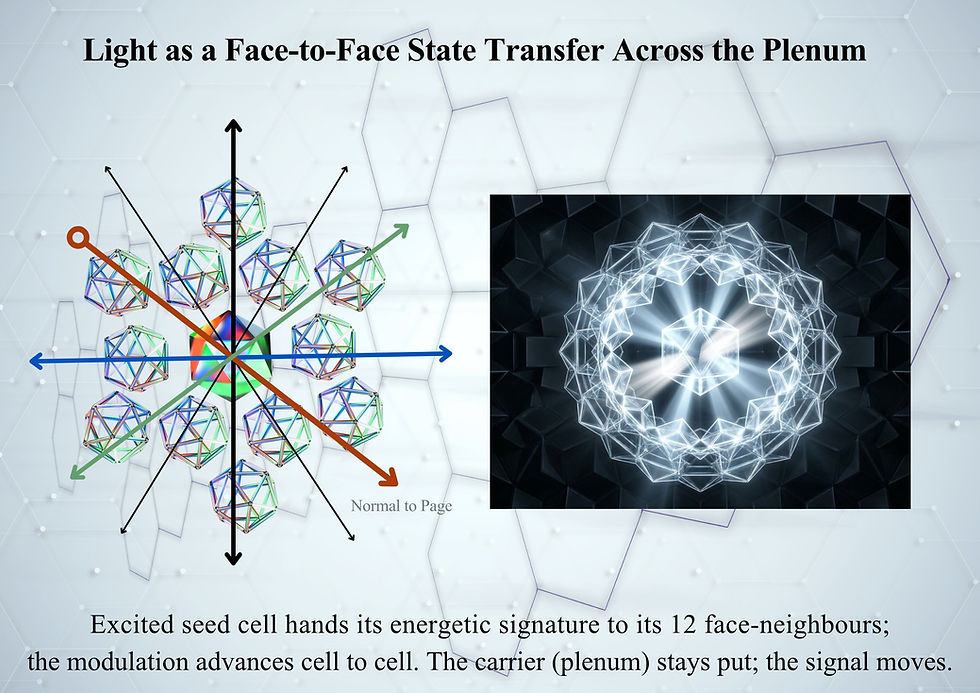
This "New Theory of 'g'" offers a radical departure from this broken geometry. It invites us to stop viewing space as a hauntingly silent vacuum and instead recognise it as a "celestial plenum", a dynamic, viscous, and compressible quantum foam. By reframing gravity as a Electrodynamic process rather than a mysterious "pull" through a void, Dr Malik resolves the singularity and redefines the universe as a cosmic ocean in which planets are not solid anchors, but porous, rotating matrices.
2. Takeaway 1: Space Isn't Empty; It’s "Quantum Foam"
The classical vacuum is an illusion of "nothingness". This theory replaces this void with the Celestial Plenum, a medium of such infinite fineness that it eludes our macroscopic senses. This shift explains the oldest paradox in the study of gravity: why an object in a vacuum chamber falls exactly as it does in the open air.
If gravity were merely a property of the environment, one might expect the thick steel walls of a vacuum chamber to shield its contents from the "force" of gravity. Yet, the observer inside feels no reprieve. He argues that this is because we are not removing the medium of gravity when we pump out the air; we are merely removing a coarse fluid to reveal a finer one.
"The steel walls of the vacuum chamber are 99.999% empty space at the subatomic level. To the infinitely fine fluid of the celestial plenum, the steel chamber is entirely permeable. The planetary ether vortex flows directly through the atomic lattice."
In this view, the "haunting silence" of the vacuum is a busy highway of plenum flow. The vacuum chamber merely eliminates the upward buoyancy of air, allowing the raw, unmitigated downward flow of the plenum to exert its full mechanical influence.
3. Takeaway 2: Gravity is Plenum Drag, Not an Invisible Pull
To understand how this plenum creates weight, he introduces the concept of the bipartisan nature of mass. There are types of mass: Mahatva and Gurutva.
Mahatva (Inertial Mass): The dense, non-interactive nucleonic core of the atom.
Gurutva (Effective Mass): The vast, interactive boundary formed by electron clouds.
In the "New Theory of 'g'", gravity is redefined as the physical drag exerted by the celestial plenum as it flows toward the centre of a planetary vortex. We are not being "pulled" by an invisible tether; rather, we are subatomic sieves caught in a cosmic current. As the plenum washes over our Gurutva, our electron boundaries, it encounters a drag or "stickiness". Weight is the mechanical sensation of this etheric wind dragging against the electronic envelopes of our atoms. We do not possess gravity; we are possessed by the "planetary ether vortex".
4. Takeaway 3: The Formula for Gravity Doesn't Need "G"
By discarding the notion of mass attraction, he also discards the empirical Newtonian gravitational constant (G). He derives a streamlined formula: g = Φ/r² (in a vacuum).
In this derivation, Φ (the plenum influence parameter) represents the "strength of the swirl". If the Earth is a whirlpool in the cosmic ocean, Φ is the measure of that whirlpool’s inherent intensity, its conserved systemic power. The r² in the denominator is no longer a mysterious "inverse square law" of attraction but a simple geometric reality: as fluidic torque (Φ) moves outward, it must disperse over the expanding surface area of concentric spheres (A = 4 π r²).
This electrodynamic model finds its most vivid proof in the "plumb bob" anomaly. Standard gravity assumes every weight should point to the Earth’s geometric centre. However, plumb bobs actually point "normal" (perpendicular) to the local surface. Because the Earth’s rotation creates an oblate spheroid, the fluidic vortex bulges, and the plenum presses perpendicular to these pressure curves. The plumb bob does not seek a point; it aligns with a flow.

5. Takeaway 4: The "Eye of the Storm" at the Earth’s Center
The most elegant achievement of the fluidic model is its resolution of the r=0 singularity. Classical physics treats the Earth as a solid ball; it treats it as a porous matrix.
As the inward-flowing plenum penetrates the Earth, its kinetic energy is gradually "depleted" by the volumetric drag of trillions of atomic layers. This models this internal decay through a beautiful algebraic simplification: because the drag matrix is volumetric (r³), the internal gravity g (internal) is the ratio of that volume to the surface area (r²):
g{int} is proportional to r3 / r² = r (This gets is modified with the coefficient of viscosity)

This means that as you move toward the centre (r to 0), gravity does not explode into infinity; it decays to zero. The paper describes the Earth’s centre as the "Eye of the Storm". It is a region of immense static pressure from the weight of the fluid column above, but it is a place of absolute calm. There is no rotational shear and no flow velocity. The singularity is gone, replaced by a zero-gravity, high-pressure equilibrium where the fluidic vectors from every direction perfectly cancel each other out. Placed below is the comparative data.
Region | Depth (km) | r (km) | Cρ | gelectro (m/s²) | gPREM (m/s²) | Difference (%) |
Surface | 0 | 6,371 | 1.000 | 9.89 | 9.81 | +0.8 |
Upper mantle | 300 | 6,071 | 1.169 | 9.32 | 9.95 | −6.3 |
Transition zone | 600 | 5,771 | 1.349 | 8.93 | 10.01 | −10.7 |
Lower mantle | 800 | 5,571 | 1.476 | 8.76 | 9.98 | −12.2 |
Lower mantle | 1,000 | 5,371 | 1.607 | 8.66 | 9.95 | −12.9 |
Mid mantle | 1,250 | 5,121 | 1.779 | 8.60 | 9.92 | −13.3 |
Mid mantle | 1,500 | 4,871 | 1.958 | 8.64 | 9.90 | −12.7 |
Deep mantle | 2,000 | 4,371 | 2.340 | 8.98 | 10.00 | −10.2 |
Deep mantle | 2,500 | 3,871 | 2.754 | 9.73 | 10.30 | −5.5 |
CMB peak | 2,890 | 3,481 | 3.100 | 10.68 | 10.68 | 0.0 |
Centre | 6,371 | 0 | ∞ | 0.00 | 0.00 | 0.0 |

6. Takeaway 5: Historical Anomalies Re-explained as Fluid Dynamics
This framework offers a fresh lens for historic experiments that have long been seen as "proofs" of more abstract theories:
The Michelson-Morley Experiment: Often cited as the death of the "ether", this experiment failed to find an "ether wind". In this model, the Earth’s interactive boundary (Gurutva) carries a layer of the plenum with it. We don't feel a wind for the same reason a passenger inside a moving car doesn't feel the breeze: we are in a "boundary layer entrainment", where the local fluid moves with us.
Fluidic Refraction and the Shapiro Delay: When radio signals slow down near the Sun, we are told space is "warped". Dr Satinder Singh Malik suggests a simpler mechanical cause: the dense central impeller of the solar vortex increases the density of the plenum (ρ{foam}), changing its refractive index.
"The radio delay is a standard fluid-dynamic refractive event governed by a changing refractive index nρ. Spacetime curvature is the geometric map of fluidic pressure gradients."
7. Conclusion: Beyond the Singularity
The new theory of 'g' does more than fix a mathematical glitch; it re-enchants our relationship with the physical world. By decoupling gravity from the intrinsic property of mass and viewing it as an electrodynamic process, we move away from a universe of cold, empty voids and toward one of vibrant, mechanical connection.
We must eventually ask, 'What is the nature of the ground we stand on?' Is it a solid rock suspended in a vacuum, or a porous matrix drifting within a vast, swirling cosmic ocean? If gravity is drag, then we are not merely standing on a planet; we are anchored within a great celestial flow, passengers on a subatomic sieve, held in place by the very medium we once thought was nothing.


Comments