
The Lion of Bhatinda: Metaphysical Continuity in the Life of Group Captain Yatindra Chauhan
- SS Malik
- May 9
- 7 min read

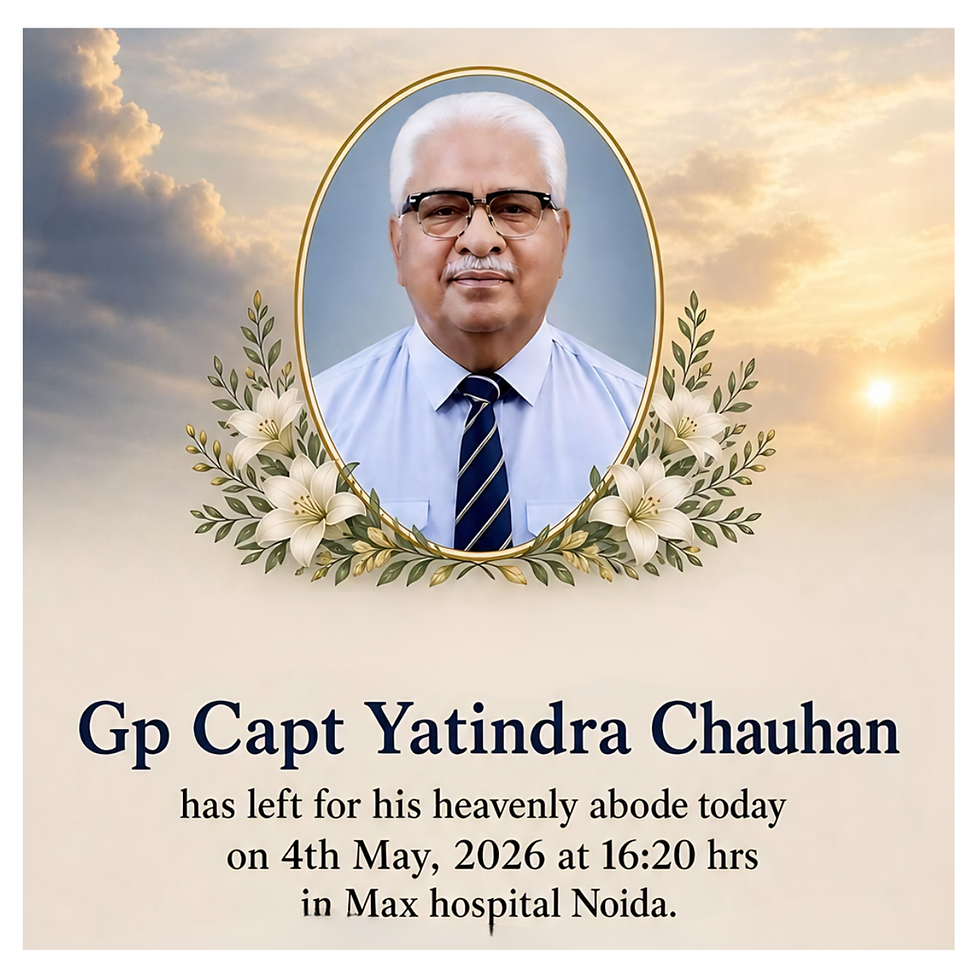
The annals of the Indian Air Force (IAF) are traditionally populated by accounts of tactical brilliance, technological progression, and the stoic endurance of its personnel. However, the biography of Wing Commander Yatindra Chauhan presents a singular synthesis of high-stakes aviation and a profound metaphysical journey that challenges conventional materialist frameworks. His career, spanning the operational peak of the HF-24 Marut and the strategic transitions of the 1980s and 1990s, is anchored by a miraculous survival incident at Air Force Station Bhatinda in 1984.
Beyond the cockpit, Group Captain Chauhan’s life was defined by a persistent and detailed recall of a previous incarnation as a police officer, a narrative that integrated seamlessly into his professional identity and was physically marked upon his person.
The author was a student who witnessed a MiG-21 settling into the dust of Bhatinda in 1984. To satisfy his curiosity, he searched the incident records while he was posted at Bhatinda but couldn’t find any record. The obituary of Group Captain Yatindra Chauhan provided him the final piece of a puzzle that began decades ago. The story of a pilot who lived a remarkable life with courage, finally finding peace after a "wonderful rebirth".
The Operational Landscape of the 1980s
The year 1984 was a period of significant strategic density for the Indian Air Force. Air Force Station (AFS) Bhatinda, located in the sensitive western sector, served as a vital node for air defence and strike capabilities. During this window, the transition from older subsonic and transonic platforms to supersonic interceptors was in full swing, yet the HF-24 Marut remained a cornerstone of ground-attack operations in the desert and plains.
HF-24 Marut was an ambitious project, representing India’s first major foray into indigenous fighter design. While the airframe, designed by Kurt Tank, was aerodynamically superb, the aircraft was perpetually hampered by its powerplants. The Bristol Siddeley Orpheus 703 engines provided insufficient thrust for the aircraft to reach its intended Mach 2 performance, leaving it in the transonic regime.
Strategic Significance of the Western Sector
The airbases in the Punjab and Rajasthan sectors were characterised by high sortie rates and rigorous training schedules. Bhatinda, specifically, was a hub for both operational squadrons and the staff officers who managed the complex logistical requirements of a frontline base. As the Chief Operations Officer (COO) at Bhatinda in 1983-84, Wg Cdr Yatindra Chauhan was responsible for the orchestration of flying efforts, airfield safety, and the integration of diverse aircraft types into a cohesive defensive posture. This role required not only administrative acumen but also a continued mastery of the flight line, as COOs were expected to lead by example in the air.
To understand Gp Capt Chauhan’s professional background, one must examine his tenure as a Flight Commander (Flt Cdr) of No. 31 Squadron, known as the “Lions”. While Chauhan served with the squadron in Jodhpur between 1979 and 1980, the unit’s history reflects the broader trajectory of the IAF’s modernisation. Originally equipped with the Mystère IVA, which performed admirably during the 1971 conflict, the squadron later transitioned to more advanced platforms like the MiG-23.
The cultural ethos of the "Lions" was one of aggressive proficiency, a trait Chauhan embodied throughout his career, particularly during his time with No. 10 Squadron, where he topped the inter-command gunnery meet in rocket firing.
The 1984 Bhatinda Incident
On the day of the incident in 1984, Wg Cdr Yatindra Chauhan was piloting a MiG-21 M (T-96), tail number C-1547. The mission was a Precision Approach Radar (PAR) approach, a standard procedure where a ground controller provides vertical and lateral guidance to the pilot. As he initiated a low overshoot—a common training manoeuvre where the pilot descends to the runway threshold before climbing away—the aircraft was in its most vulnerable state, as the undercarriage was in the process of retraction, the flaps were set to 45 degrees and boundary layer control (BLC) was active, using engine bleed air.
At this critical juncture, a mechanical failure occurred in the variable exhaust cone of the Orpheus engine. The cone "shot to 100%”, which in the parlance of the R-13 engine means the intake was restricted to its narrowest passage. This caused an immediate "loss of thrust" because the engine intake was being constricted.
With the flaps at 45 degrees creating massive drag and the BLC failing due to reduced engine pressure, the flight became “unsustainable”. The aircraft could no longer maintain its altitude or airspeed and began to "settle", a term for a slow, flat descent where the aircraft loses altitude despite a nose-high attitude.
The aircraft settled past the Middle Marker (MM), which is situated approximately 0.8 nautical miles from the runway threshold. Wg Cdr Chauhan’s survival was the result of a unique alignment of random factors and instinctive airmanship. The aircraft was carrying two 490-gallon drop tanks (DTs) on its underwing pylons.
When the aircraft contacted the ground, it did not impact the fuselage directly. Instead, the two massive drop tanks took the initial force of the impact. They acted as shock absorbers and skids, preventing the aircraft from cartwheeling or digging into the soft earth before it reached the paved surface of the runway. The aircraft stayed on an "even keel”, sliding along the runway surface and creating a long screeching noise which could be heard a mile away. Wg Cdr Chauhan switched off the engines and streamed the brake parachute, which provided the necessary deceleration to stop the aircraft on the runway.
The aircraft stopped with relatively little damage, a testament to the ruggedness of the Russian airframe. However, the immediate impact on the base's operations was profound, as it created a tactical emergency for other aircraft in the air. This occurred during the "first detail”, a time of high activity when multiple training sorties are launched.
The Logistics of a Sudden Runway Closure
At the time of the crash, several junior and senior pilots were in the air. These included a pilot on his first "2-aircraft lead" (2ac lead) sortie and another pilot, “Kelly”, flying his last "2-aircraft lead clearance” (2 ac LC) with a senior instructor, Wg Cdr Sarao.
With the runway blocked, the Standard Operating Procedure (SOP) for fuel-critical aircraft was to divert to the nearest alternate airfield. In this case, seven aircraft were forced to divert to AFS Sirsa. The diversions included several pilots whose names remain part of the collective memory of that era.
The fact that this incident is not easily found in digitised historical records is typical of the era. Before the advent of comprehensive digital flight safety databases, incidents that did not result in a "write-off" (total loss) or a fatality were often recorded only in squadron diaries and station flight safety files. For a pilot like the user, searching for this incident decades later, the lack of a public record often masks the significant operational impact such events had at the time.
The Metaphysical Dimension: Reincarnation and the Fighter Pilot
While the 1984 incident was a defining moment of technical survival, the broader story of Group Captain Yatindra Chauhan is inextricably linked to his claims of reincarnation. In the rationalist world of the military, such claims are often met with scepticism, yet Chauhan’s narrative was so consistent and detailed that it gained a level of acceptance among his peers in the IAF mess.
The Recall of the Previous Life
Chauhan’s memories of a previous life were not vague or abstract. He identified himself as having been a police officer in a previous incarnation. The details he provided centred on a violent end: he claimed to have died during an encounter with dacoits, the organised bands of outlaws that were a significant security threat in central India for decades.
According to his account, he was struck in the chest by a bullet. This specific trauma from a previous life was manifested in his current body. At birth, he was reportedly bleeding from the chest at the exact site of the remembered wound. This wound eventually healed but left a permanent mark—a "black spot"—which was sufficiently distinct to be officially recorded as an identification mark on his Indian Air Force ID card.
The phenomenon of birthmarks corresponding to wounds in a remembered past life has been studied by researchers such as Dr Ian Stevenson. In the context of Chauhan’s biography, this "black spot" served as a physical bridge between two identities.
The Recognition of Soulmate
One of the most compelling aspects of Chauhan’s story was his recognition of his wife from his previous life. This encounter allegedly occurred when he was only three or four years old. Chauhan was born into the same extended family or a closely related social network, which provided the opportunity for this recognition.
He reportedly provided specific, intimate details of their life together that a child of his age could not have known. While the lady was initially sceptical, the accuracy of his recollections eventually led to an emotional acceptance. This connection was so profound that it influenced Chauhan's current life choices, including a significant delay in his marriage as he reconciled his past emotional ties with his present reality.
During his childhood, the news of his past-life recalls generated significant local interest. Crowds of people would gather to see the child who remembered being a policeman. This placed an immense burden on the family and disrupted the child’s upbringing. In a move of pragmatic protection, his father began telling the public that the boy was “delusional”.
This was not a rejection of the son's claims but a tactical defence to disperse the crowds and allow Yatindra to have a normal childhood. Within the private sphere of the family the story remained a credible and deeply felt narrative.
The Credibility of the Narrative
When Gp Capt Chauhan was the COO at Tezpur in 1995, he had shared his story with colleagues. His peers described him as "a very nice person" and found his account "very believable”. This acceptance stems from the consistency of the details and Chauhan’s own grounded, professional demeanour. He was not a man given to flights of fancy; he was a combat pilot who topped gunnery meets and managed the complex operations of a frontline airbase.
The Marut Reunions and the Veteran Community
In his later years, Chauhan remained an active participant in the "Marut reunions”, such as the one held in 2010. These gatherings served as a repository for the oral history of the IAF, where incidents like the 1984 belly landing were recounted and preserved. The Marut, despite its flaws, fostered a deep sense of camaraderie among its pilots, who often referred to themselves as "Marutians".
A perspective on reality
The life of Wing Commander Yatindra Chauhan represents a rare intersection of the tangible and the intangible. As a fighter pilot, he operated in a world of precise measurements, aerodynamic limits, and technical acumen. His survival at Bhatinda in 1984 remains a classic example of high-stakes airmanship in the face of challenges.
His story provides a unique perspective on existence, one that he carried with dignity and professionalism. It is not an isolated case but mirrors the nearly 3000 cases documented by Dr Stevenson. It not only proves the wisdom of Bhagavad Gita but also that the perspective of Sanatan Dharma on life and its reality is the most authentic.



Comments