
The Shape of Cosmos
- SS Malik
- May 10
- 11 min read

Updated: May 11

Abstract
This paper presents a rigorous philosophical and scientific re-evaluation of cosmic architecture by first drawing an etymological distinction between the “universe” and the “cosmos”. Synthesising ancient Vedic ontologies, including the Samkhya concepts of Mahat and the three Gunas, with contemporary astrophysical anomalies such as the Planck 2018 preference for a closed universe, the Hubble tension, large-scale bulk flows, and spinning cosmic filaments, the study proposes a globally spherical and topologically toroidal visible cosmos.
Space is modelled not as a vacuum but as a “celestial plenum” filled with variable-density quantum foam, a fluidic medium in which space and time are dynamic substances governed by primordial intelligence. Within this plenum, mass is redefined as an effective, local, and relative property arising from a body’s interaction with its environment, while gravity is reinterpreted as adhesion to the medium’s streamlines. A universal nucleus stability principle is demonstrated: all stable material systems, from atoms to the cosmos itself, require a dominant central mass to anchor coherent motion.
The observed planar distribution of matter therefore reflects the radial forces of a central cosmic bulge, which drives a hydrodynamic gearing mechanism that transmits angular momentum through the cosmic web to individual galaxies. The paper argues that metric expansion and galactic redshift are not kinematic recessions but refractive misperceptions caused by the medium’s density gradient, removing the need for a linear 13.8‑billion‑year timeline. A holographic outer boundary, where formatted quantum foam ceases, mirrors light and produces phantom galaxy images, explaining the illusion of an infinite universe, while the inner side of the disc remains dark and gravitationally anchored. Ultimately, the cosmos is presented not as a stochastic accident but as a purpose‑driven, energy‑conserving architecture formatted for the evolution of consciousness, resolved by the interplay of Sattva (intelligence), Rajas (motion), and Tamas (mass‑energy). This framework yields a self‑consistent foundation for future testable hypotheses.
1. Introduction: The Terminological Pivot
The quest to understand the origin and shape of the totality has been hindered by a semantic conflation. Modern cosmology often uses the term "universe" to describe the entirety of existence. However, etymologically, the prefix "uni-" (one) suggests a singular unit, a "single verse". In this analysis, the "universe" has been interpreted as a primary constituent, such as a galaxy1. The "cosmos", conversely, denotes the ordered, harmonious arrangement of all such units.
While modern science seeks a "Theory of Everything" through mechanistic reductionism, this paper proceeds via "A Logic of Every Being", a darshana (perspective) that integrates the observer as a fundamental variable in cosmic structure1. It presents the argument that the cosmos is a "Big Bloom", a metaphorical and literal process of development, beauty, and purpose, contrasting with the chaotic implications of a "Big Bang"1.
2. Chronological evolution of Cosmic Shape Theories
The human endeavour to map existence has evolved through distinct phases, each defined by its own geometric paradigm and eventual limitations. In the Rig Veda and Brahmanda Purana, direct perception was the tool for such knowledge. In Greek philosophy it was logic. These theories vary from ancient philosophical ideals of "perfection" to modern mathematical models based on general relativity and satellite data. Early thinkers focused on geometric simplicity, while today's cosmologists use high-precision measurements of the early universe to determine its curvature and topology.
This paper uses ‘upmana’, or the logic of the Indian philosophical system Samkhya, while correlating it with modern mathematics-based theories. The following tables explore various models of cosmic shapes historically.
Model Period | Principal Developer | Core Geometry | Primary Limitation |
c. 15000 BCE | Vedic Rigveda | Brahmanda (Cosmic Egg) | Qualitative/ Metaphysical focus3. |
c. 600 BCE | Babylonians | Flat Disc in Ocean | Scalability and star-tracking3. |
c. 546 BCE | Anaximander | Cylinder | Lacked gravitational mechanics3. |
c. 350 BCE | Aristotle | Geocentric Spheres | Ideological, failed to predict planetary paths3. |
c. 150 CE | Ptolemy | Epicyclic Spheres | Extreme mathematical complexity3. |
1543 CE | Copernicus | Heliocentric | Assumed perfect circular orbits3. |
1644 CE | Descartes | Vortex Plenum | Inconsistent with Kepler's Laws7. |
1687 CE | Newton | Static Euclidean | Unstable distribution of matter3. |
1916 CE | Einstein | 4D Space-Time | Singularity & quantum tension9. |
2015 CE | Planck Mission | Euclidean (Flat) | Local perception vs. global topology9. |
2018 CE | Melchiorri et al. | Closed Sphere | Tension with local data10. |
3. The Mechanistic Fallacy: Defeating the Big Bang Hypothesis
The prevailing "Big Bang" paradigm relies on the concept of a "primaeval atom" or singularity, a point of infinite density and zero volume. This conceptualisation is logically and physically tenuous. Standard GR equations suggest expansion can be tracked back to a singularity, yet these equations are fundamentally incompatible with quantum mechanics at the Planck scale11.
The Big Bang theory assumes a chaotic explosion, yet the universe we observe is built to perfection, with interdependent systems acting in harmony and without wastage1. Furthermore, the odds of life-compatible fundamental numbers arising by random chance are estimated at 1 in 10229, rendering the "accidental" mechanistic model statistically impossible2. The "Big Bloom" theory resolves this by proposing that expansion follows Mahat, the cascading principle of mass generation or ‘massivity’, ensuring that growth is planned and beauty is inherent to simplicity1.
4. The Globally Spherical and Toroidal Cosmos
Logical inference dictates that the global expanse of space-time must be spherical. A spherical design is close-ended, ensuring that energy remains conserved within the system rather than dissipating into an open-ended void1.
4.1 The Curvature Crisis
In 2015, the Planck mission released data suggesting the cosmos is geometrically flat with a high degree of precision ()1. However, re-analysis of the 2018 "legacy" data by a team led by Alessandro Melchiorri revealed an enhanced lensing amplitude ( parameter) that favours a "closed" or spherical universe with over 99% confidence10. This model suggests the universe is approximately 4% more curved than previously believed10.
The discrepancy between the perceived flatness of the local universe and the global spherical reality is a matter of scale. Just as the Earth’s surface appears flat to a terrestrial observer, the local cosmos appears flat due to its immense size1.
4.2 The Doughnut (3-Torus) Model
It is proposed that the observable cosmos represents a limited cross-sectional sphere of a much larger doughnut-shaped (toroidal) ring1. A 3-torus topology allows for a universe that is finite yet boundless, satisfying the observed flatness while reconciling the closed curvature anomalies11. In this model, space-time dynamically flows; it expands at the "top" where it emerges from the core and contracts at the "bottom" as it returns11.
5. Moola Prakriti: The Velocity of Thought
The origin of the cosmos is inferred to have started from a Bindu (point) through the sustained, purposeful thought of prime consciousness1. This willpower is termed Moolaprakriti (root nature), the primal vibration and hardware of existence1. The expansion was driven by "thought waves" of Moolaprakriti, which are essentially instantaneous and resemble the rapid inflation observed in standard models1. These waves have three attributes of existence (energy, or Tamas), flow (control, or Rajas), and intelligence (Sattva). Intelligence carves out or formats the space; flow creates a sequence, and energy oscillates as a result. In this manner, these waves used a vast initial space to form complex interference patterns, leading to quantum vacuum fluctuations and the unified field, the birthplace of subatomic particles1. As waveforms become laden with attributes such as frequency and amplitude, their velocity gets reduced from the instantaneous thought energy to the slower speeds observed in the physical world, such as light1. This "formatted airspace" prevents energy from being lost; the border of the cosmos is where the energy flow is directed along the circumference or redirected inward1.
6. The Refractive Mirror: Challenging Redshift and Expansion
One of the most significant arguments to defeat is the metric expansion of space based on galactic redshift. Edwin Hubble observed that distant galaxies have redshifts proportional to their distance. The standard interpretation, the Doppler effect, implies galaxies are physically moving away from us. However, this interpretation leads to the absurdity that more distant galaxies would have to "know" they must move faster to maintain proportionality14.
6.1 Redshift as a Refractive Misperception
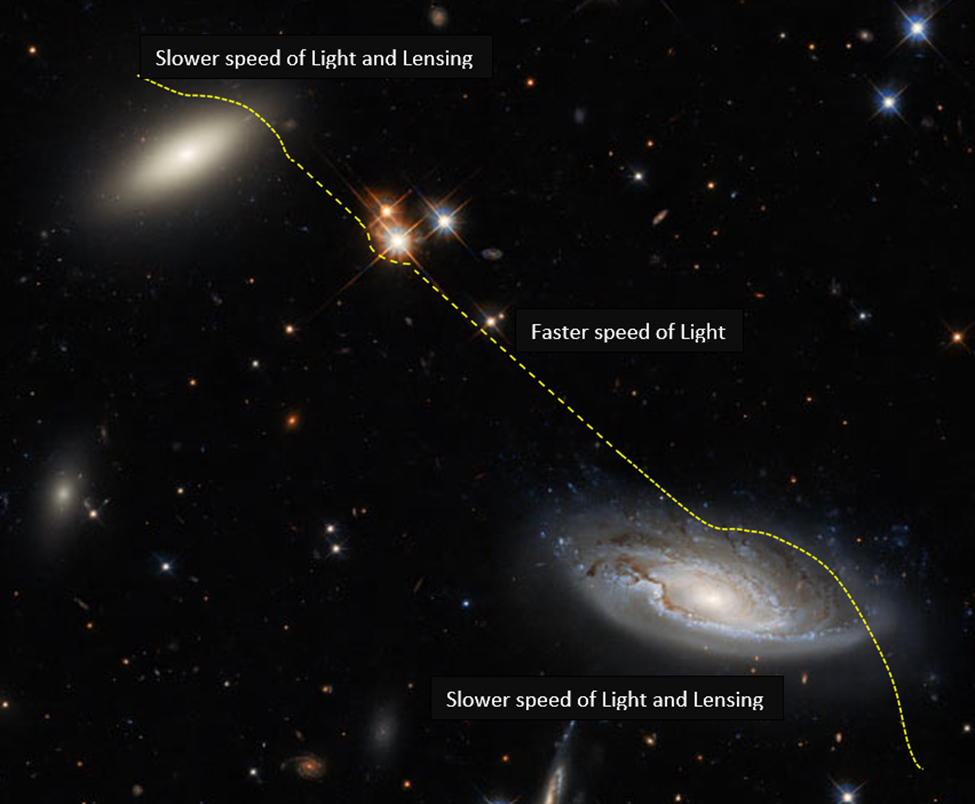
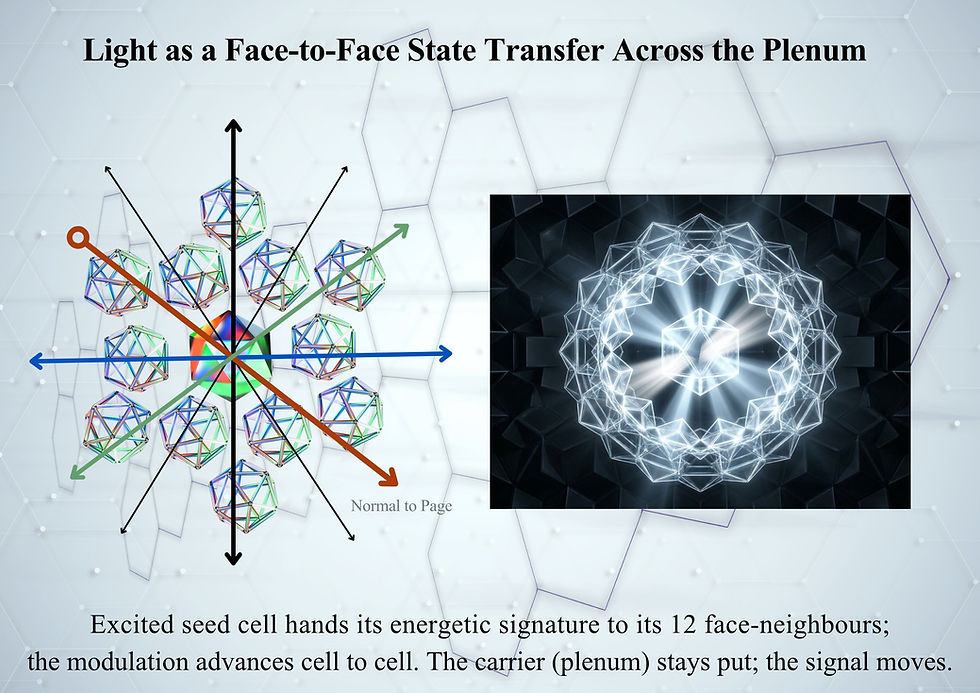
This paper proposes that redshift is not a measure of velocity but an optical effect of the variable-density "celestial plenum". If space is a fluid medium (quantum foam), its density is not uniform; it is denser near massive objects and the cosmic centre⁷.
Light travelling through this medium is subject to a refractive index (n=c/v). Just as light slows down and bends (refracts) when entering water, it undergoes a "wave propagation delay" or viscous drag when moving through dense layers of quantum foam1. This refractive wavelength shift creates the illusion that the cosmos is expanding faster than light1. Furthermore, the assumption of a 13.8 billion-year age is based on a linear time model that ignores the extreme time dilation in dense gravity wells (such as near galactic centres); the time may be absolute as a sequence of events in the cosmos, but what we experience is relative, so the Big Bang age is certainly incorrect1.
7. Spatial Architecture: The Triguna Distribution
Vedic cosmology, specifically Samkhya Karika 54, provides a precise distribution for the internal structure of the cosmic spheroid based on the three Gunas: Sattva (intelligence/light), Rajas (motion/action), and Tamas (massivity/energy)1.
ऊर्ध्वं सत्त्वविशालस्तमोविशालश्च मूलतः सर्गः । मध्ये रजोविशालो ब्रह्मादिस्तम्बपर्यन्तः ॥ ५४ ॥
The top and bottom of the cosmic sphere are vast Sattva; the root of this creation is Asat (unformatted) and Tamas, and the centre abounds in Rajas. Brahman, etc., are situated or pervade forever. It indicates the centre of the cosmos with a big source of Tamas (energy). It could be in the form of a huge dark star capable of holding all the galaxies together. It is also a centre for Sattva guna, indicating intelligence (space), and the middle part of the cosmos is control-centric or influenced by time.

● The Poles (Top and Bottom): Dominated by Sattva and Tamas. These higher worlds are centres of cosmic intelligence and energy foundation1.
● The Middle Region: Abounds in Rajas. This represents the control-centric part of the cosmos where motion and time energy drive the unidirectional movement of the cosmic disc1.
Matter is not distributed uniformly throughout the cosmic sphere but is condensed along this Rajasic plane, forming a thick disc that mimics the structure of a galaxy1. One of the inferences that can be drawn from the above is that the direction in which we find the disappearing galaxies and endless universe is the outer and holographic side, whereas the inner side is the side with no disappearing galaxies and stars and complete darkness. That complete darkness is the darkness of the central dark star.
8. The Central Dark Star: Gravitational Anchor
Unlike galaxies, which are thought to originate from central black holes, the cosmos possesses a specialised anchor at its core. The paper infers the existence of a huge "dark star" at the geometric centre of the toroidal cosmos1.
This Dark Star is a massive source of Tamas (dense energy) capable of holding all galaxies together in their unidirectional motion1. It absorbs light to repurpose it in the formation of pre-matter particles, acting as the input-output mechanism for the cosmic disc1. The existence of such a "Great Attractor" at the cosmic scale explains why large-scale structures are moving toward specific points in space despite the overall "expansion" on the outer side and on the poles of this cosmic sphere.
9. The Holographic Mirror and the Edge
The formatted universe has a definite edge, currently calculated at approximately 92 billion light-years in width1. This boundary separates the "formatted" airspace of our reality from "unformatted" non-existence (Asat)1.
The unformatted airspace acts as a mirror, lacking the structure to transmit internal energy. This energy bounces back into the cosmos, forming "ghost images" or facsimiles of internal stars and galaxies1. This "Cosmic Hall of Mirrors" makes the finite cosmos appear multifold and infinite to internal observers1. This phenomenon explains why certain galaxies appear to disappear or reappear and suggests that a portion of the cosmic map is holographic1.
10. Conclusion: The School of Consciousness
The concept of a mechanistic, accidental cosmos is an incomplete understanding of the source code of reality. The physical cosmos is a manifestation of Mahat, a planned evolution for the emancipation of spirit1.
Human consciousness evolves by indulging in experiences within this structured architecture. If a spirit evolves sufficiently, it is utilised to play more significant roles in the governance of the cosmic formations in the future1. By reconciling the "Seen" (baryonic matter) with the "Unseen" (the celestial plenum and central intelligence), we move toward a "Logic of Every Being" that reveals the purposeful, perfect design of the cosmos.
References
1. Malik, S. S.: The Shape of Cosmos: Universe Shape Research.
2. Malik, S. S.: Metaphysics of Space-Time.
3. Weygaert, R. Cosmology Timeline: From Mesopotamians to Planck. University of Groningen.
4. The Physics of the Universe. "Cosmological Shape Theories: Brahmanda".
5. Wikipedia. Timeline of Cosmological Theories.
6. Jeffery, D. History of Cosmology. UNLV Astronomy.
7. Malik, S. S. Gravity and Inertia in the Celestial Plenum: A Re-evaluation via Quantum Foam.
8. Rational Realm. "Critical Turning Points in the History of Cosmology".
9. Wikipedia. Shape of the universe.
10. Di Valentino, E., Melchiorri, A., & Silk, J. (2019). "Planck evidence for a closed universe and a possible crisis for cosmology". Nature Astronomy.
11. Bladon, L. "The Toroidal Universe Theory". LeeBladon.com.
12. Hindu Infopedia. "The Vedic Blueprint of Creation Unfolded".
13. Cornish, N. J., Spergel, D. N., & Starkman, G. D. "Compact Collaboration: Probing Cosmic Topology". Quanta Magazine.
14. Shamir, L. (2024). "Shamir study supports Tired Light theory, challenges Big Bang." Kansas State University.
15. Wikipedia. Superfluid vacuum theory.
16. Samkhya Karika. Verse 54 regarding spatial or cosmological structure.
17. Luminet, J. P. (2005). "A Cosmic Hall of Mirrors". Scientific American.
18. Dhenuva Konda, S. "The Holographic Universe". Journal of Young Physicists.
19. Volovik, G. E. (2003). The Universe in a Helium Droplet. Oxford University Press.
20. Ahmed Ali. (2024). "The Unified Consciousness Field Theory". ResearchGate.
21. Schrödinger, E. (1944). What is Life? "The Order-from-Order Principle".
Editorial Note on "The Shape of Cosmos" by Dr Satinder Singh Malik
This paper is a bold and original attempt to synthesise Vedic philosophical frameworks, particularly Samkhya cosmology, with contemporary astrophysical anomalies. It is best understood as a work of speculative philosophy of science rather than empirical cosmology and should be read in that spirit.
Where the Paper Stands on Solid Ground
Several of the scientific reference points cited are authentic and well-established in current literature. The Planck Legacy 2018 data did confirm an enhanced lensing amplitude in the cosmic microwave background power spectra, and a re-analysis by Di Valentino, Melchiorri, and Silk found that a closed or spherical universe could provide a physical explanation, with positive curvature preferred at more than 99% confidence. This is a real and published scientific finding, correctly cited by the paper. Nature
Similarly, the Hubble tension is a genuine and unresolved problem in modern cosmology. As of late 2025, the Hubble tension persists as a statistically significant discrepancy of approximately 5 sigma, with two highly precise measurement methods yielding incompatible results for the rate of cosmic expansion. The paper's invocation of this crisis to question the standard model is therefore on legitimate ground. New Space Economy
The 3-torus (toroidal) topology of the cosmos is also a serious, ongoing scientific hypothesis. The topology of the universe remains far from settled, and many possible shapes, including various toroidal configurations, have not been contradicted by existing evidence, according to recent cosmological research. American Physical Society
Where the Paper Ventures into Speculation
The paper's core framework, that the cosmos originated from Moolaprakriti (primal consciousness), that redshift is a refractive misperception rather than evidence of expansion, that a "Central Dark Star" governs cosmic motion, and that the boundary of the cosmos acts as a holographic mirror, are philosophical and metaphysical propositions. They are drawn from Vedic and Samkhya traditions and are not independently verifiable through current scientific methodology. The paper itself acknowledges this, framing its approach as darshana (perspective) rather than empirical proof.
The claim that the odds of life-compatible physical constants arising by chance are "1 in 10²²⁹" is a figure that appears in fine-tuning arguments in philosophy of physics, but its precise value is contested and model-dependent; it should not be treated as a settled scientific fact.
The dismissal of galactic redshift as a "refractive misperception" due to variable-density quantum foam, while imaginative, runs counter to the substantial converging evidence from multiple independent measurement methods, Type Ia supernovae, baryon acoustic oscillations, and CMB data, that all independently support cosmic expansion.
Overall Assessment
The paper's historical survey of cosmological models is accurate and well-organised. Its engagement with real anomalies in modern cosmology, the curvature crisis and the Hubble tension, lends it intellectual credibility as a philosophical intervention. However, readers should be aware that the paper's constructive proposals (the "Big Bloom", the celestial plenum, the toroidal dark-star architecture mapped onto Triguna) are interpretive and speculative, rooted in a coherent but non-mainstream philosophical tradition. They are offered as a darshana, a way of seeing , and the paper is most valuable when read as a contribution to the philosophy of cosmology and the dialogue between ancient wisdom and modern science.


Comments